Persistent or recurring discomfort during training is worth paying attention to, but its causes can vary. Training load, recovery, previous injury, strength, mobility, technique and other factors may all be relevant. For many Richmond athletes, recurring symptoms or movement limitations may be worth assessing, particularly when they affect training consistency or performance.
In the CrossFit community here in Richmond, BC, athletes are constantly pushing their limits. But this drive for intensity can sometimes overshadow the need for precision. The challenge for many dedicated athletes is navigating the diverse local wellness market to find care that truly understands the unique demands of a clean and jerk, a muscle-up, or a high-volume metcon. This is where specialized kinesiology can be a supportive service for recovery and long-term athletic participation.
In BC, Kinesiology is not a government-regulated profession like physiotherapy. Always verify your practitioner is a ‘BCAK-registered Kinesiologist,’ which ensures they adhere to the BC Association of Kinesiologists’ standards for ethics and continuing education. This is your primary mark of quality in a diverse wellness market.
- Overdrive Wellness in Richmond, BC, offers kinesiology in a clinic connected to Overdrive Athletic Club, with a background in CrossFit and Olympic Weightlifting. Its kinesiologists use movement assessment and active rehabilitation to support individual recovery, movement and performance goals.
- Because kinesiology is not a government-regulated health profession in BC, consumers may consider current BCAK professional membership as one useful credential when evaluating a kinesiologist. BCAK membership includes educational, competency and professional-practice requirements.
- One relevant feature of Overdrive Wellness is its connection to a CrossFit and Olympic Weightlifting environment, which may be particularly relevant to athletes who want a practitioner familiar with those movements.
- The process involves a detailed movement assessment to explore factors that may be contributing to an athlete’s pain or movement limitations, not just treating symptoms.
- A collaborative approach, coordinating with coaches and other practitioners, can be useful when multiple professionals are involved in an athlete’s care.
What is Kinesiology and Why Does It Matter for CrossFit?
Kinesiology applies knowledge of human movement, exercise and biomechanics to support function, rehabilitation and performance goals. For a strength athlete, a kinesiologist can act as a movement detective and architect. They don’t just look at an area of pain; they may explore factors that may be contributing to the person’s symptoms, movement limitations or performance concerns. For a CrossFit athlete, this perspective can be valuable. The sport demands a vast range of skills, from the brute strength of a deadlift to the explosive power of a snatch and the gymnastic control of a handstand push-up. CrossFit and Olympic Weightlifting involve sport-specific movements that may benefit from assessment by someone familiar with their technical and physical demands. A kinesiologist with a background in strength sports can observe these patterns and identify movement or capacity factors that may be relevant to technique, training tolerance or performance.
It’s also crucial for athletes in British Columbia to understand the professional environment. Kinesiology is not a government-regulated health profession in British Columbia. The BC Association of Kinesiologists (BCAK) is a professional association rather than a statutory regulatory college. This means that while BCAK sets membership requirements and maintains professional practice standards for its members, it does not have the legal authority to regulate the profession under the Health Professions Act. Current BCAK professional membership indicates that the practitioner has met BCAK’s educational and competency requirements and agrees to follow its professional standards, scope of practice and code of ethics. This is one useful credential for consumers to consider when choosing a provider.
The Overdrive Wellness Approach: Kinesiology Born from the Barbell
Finding a practitioner who understands both the science of movement and the culture of your sport can be helpful. At Overdrive Wellness, our approach to kinesiology is informed by a background in CrossFit and Olympic Weightlifting. Our practitioners understand the frustration of a missed lift and the specific demands of a high-rep workout. This perspective allows us to connect with athletes and provide insights that are both scientifically informed and practically applicable inside the gym.
Overdrive Wellness describes its treatment philosophy as preventive, holistic and evidence-based. Rather than waiting for an injury, an assessment may identify movement, strength, mobility or capacity considerations that can inform an individualized exercise plan. Our holistic view means we consider your training schedule, recovery habits, and lifestyle to develop a comprehensive plan. Finally, our methods are grounded in available evidence. Assessment and exercise strategies are selected according to the individual, professional scope and available evidence. This approach aims to support recovery, movement capacity and individual performance goals over time.
The Kinesiology Assessment: A Deep Dive into Your Movement
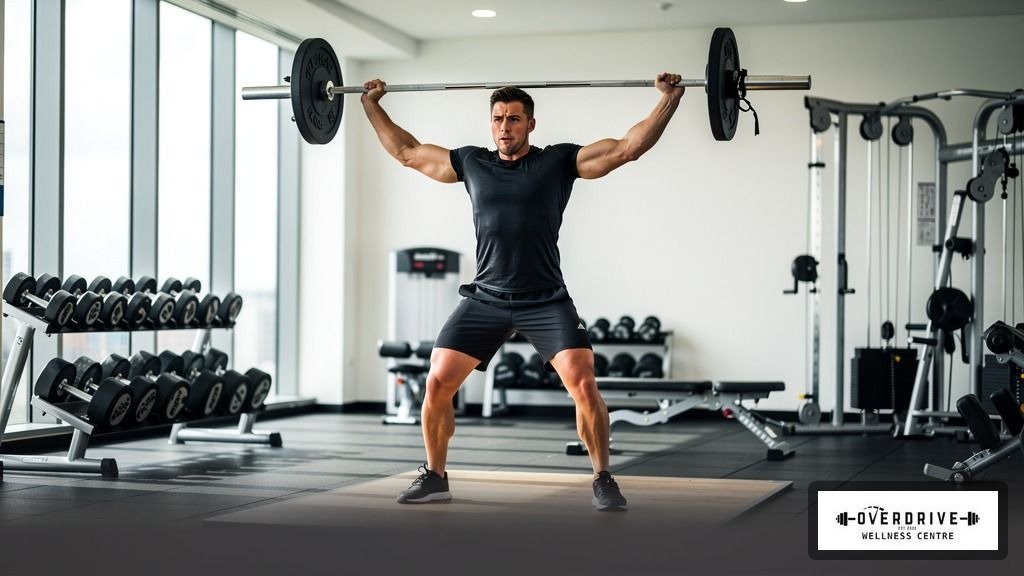
So, what does a kinesiology session for a CrossFit athlete actually look like? It begins with a comprehensive assessment that goes beyond simply asking where it hurts. We start with a detailed conversation about your training history, your current goals, your past injuries, and the specific challenges you’re facing in the gym. For CrossFit athletes, an assessment may consider sport-specific movements, training history, symptoms, strength, mobility and load tolerance rather than assuming one movement fault has one cause. This is followed by a movement-focused observation where we might watch you perform fundamental patterns like an air squat, a hinge, a push, and a pull, as well as sport-specific movements like an overhead squat or a kettlebell swing.
We are not just looking for obvious faults; we’re analyzing the quality of the movement. We observe joint mobility, motor control, stability, and how different parts of your body work together. The assessment considers factors that may contribute to the athlete’s symptoms or training limitations. For instance, during an overhead-squat assessment, a practitioner may consider shoulder motion alongside thoracic movement, lower-body mobility, load, technique and other relevant factors. A movement observation alone does not establish the cause of pain. This analytical process allows us to build a highly individualized program to address your specific limitations and work toward your goals.
These examples are educational only. The same movement pattern can occur for different reasons in different athletes, and a visual observation alone does not diagnose the cause of pain or injury.

| Training Observation | What a Practitioner May Explore | Possible Next Step After Individual Assessment |
|---|---|---|
| Pelvic/spinal position changes near the bottom of a squat. | Squat depth, stance, individual anatomy, ankle/hip mobility, load, technique, symptoms, and control at the chosen depth. | May involve modifying squat depth, stance, or load; or incorporating specific mobility or motor control exercises based on assessment findings. |
| Painful, limited, or difficult overhead movement. | Shoulder range of motion, scapular movement, thoracic movement, load tolerance, technique, symptoms, and exercise history. | May include exercises to address mobility or strength deficits, technique modifications, or activity modification based on the individual’s presentation and goals. |
| Early arm bend in a snatch or clean. | May reflect the athlete’s current lifting strategy, timing, technique, or response to the load. A qualified coach or practitioner would observe the full lift sequence. | If deemed relevant, coaching strategies might include drills that emphasize leg drive and timing, such as block cleans or tall snatches, selected based on the athlete’s specific needs. |
Persistent, worsening or significant pain should not be self-diagnosed from a movement checklist. An appropriate healthcare professional can help assess symptoms and determine whether further evaluation is needed.
Integrating Kinesiology Into Your Training Ecosystem
A kinesiology assessment is the starting point. The true value comes from integrating the findings into your daily training routine to build better habits. This isn’t about adding another hour of work to your already packed schedule. It’s about integrating relevant exercises or modifications into the athlete’s existing training where appropriate. This could mean a personalized 10-minute warm-up that may include exercises for your ankle mobility or glute activation before you squat. It might involve specific accessory exercises after your main workout to address findings from your assessment. The goal is to weave these strategies seamlessly into your existing program.
We also believe in a team approach to athlete care. Overdrive Wellness emphasizes collaboration with other practitioners to offer comprehensive care plans. Your body is a complex system, and coordination can be useful when multiple practitioners or coaches are involved in an athlete’s care. We work closely with your CrossFit coach to ensure our recommendations align with your programming and goals. If you’re also seeing another healthcare practitioner involved in your care, such as a Chiropractor for joint health, we can communicate with them to ensure everyone has a consistent understanding of relevant goals and recommendations. This collaborative ecosystem of care can provide a support network, ensuring all aspects of your health and performance are considered. Check out our full range of services to see how we can build your support team.
Finding Your Kinesiologist in Richmond, BC
For CrossFit athletes in Richmond, the number of wellness options can be hard to navigate. One useful step is to check whether the practitioner is a current BCAK professional member and review their education, experience and areas of practice. Second, look for experience that aligns with your needs. A prospective client can ask about the practitioner’s experience, assessment process and approach before booking. Ask them about their experience working with strength athletes or CrossFitters and how they can help you achieve your specific goals.
- Are you currently a BCAK Practicing Member?
- What experience do you have with CrossFit or Olympic Weightlifting?
- What does the initial assessment involve?
- How do you coordinate with my coach or other healthcare practitioners if needed?
- How will progress be assessed?
- What should I do if symptoms worsen?
You’re looking for a partner in your training—someone who can provide objective feedback, expert guidance, and a clear plan. The right kinesiologist will empower you with knowledge about your own body, helping you become a more informed athlete. Some athletes use kinesiology as part of a broader strategy for managing training demands, recovery and individual movement goals. It is one possible supportive service for athletes who want to continue doing the sport they love for the long haul. The practitioners on our team are ready to be that partner for you.
Ultimately, kinesiology for a CrossFit athlete is about understanding and managing movement and training variables to support individual goals. It’s about using individualized exercise and appropriate collaboration to address training concerns and support an informed return to activity. If you’re ready to move beyond just managing symptoms and start building a more informed approach to your training, it’s time to explore what specialized kinesiology can do for you. Contact Us at Overdrive Wellness today to discuss your goals and book an initial assessment with one of our kinesiologists.
Frequently Asked Questions
Is kinesiology regulated in British Columbia?
No, kinesiology is not a government-regulated health profession in BC. The British Columbia Association of Kinesiologists (BCAK) is a professional association that sets standards for its members, but it is not a statutory regulatory college under the Health Professions Act.
Can a kinesiologist help a CrossFit athlete with an injury?
Within their professional scope, kinesiologists may provide active rehabilitation and exercise therapy to support recovery from injury. The most appropriate professional to see depends on the individual’s specific condition, symptoms, and needs. A kinesiologist can be one part of a healthcare team.
What happens during a kinesiology assessment for a CrossFit athlete?
An initial assessment typically includes a detailed discussion of your training and symptom history, your goals, and your current challenges. This is often followed by observation of relevant movements (from general patterns to sport-specific lifts) to inform an individualized exercise or rehabilitation plan where appropriate.
Disclaimer: This article provides general educational information and is not a diagnosis or substitute for individualized healthcare advice. Pain and injury can have multiple causes. If you have persistent, worsening or significant symptoms, consult an appropriate healthcare professional.
Written by: [Author Name]
Reviewed by: [Reviewer Name, Credentials]
Last reviewed: 7 September 2026
Changes Made
* Revised the introduction to remove diagnostic claims and injury prediction, focusing on the multifactorial nature of pain and the value of assessment.
* Corrected terminology for BCAK, clarifying it is a professional association, not a regulatory college, and changing “BCAK-registered” to more accurate terms like “BCAK professional member.”
* Adjusted key takeaways to remove “unique advantage” and claims of BCAK being the “primary mark” of quality, replacing them with more nuanced and factual statements.
* Removed the implication that BCAK membership “ensures” evidence-based care, stating instead that members agree to follow professional standards.
* Refined the definition of kinesiology and removed claims of finding a single “root cause” of pain, shifting focus to exploring “contributing factors.”
* Removed criticism of “general fitness” and vague marketing terms like “energy leaks.”
* Attributed the clinic’s philosophy (“preventive, holistic, evidence-based”) to the clinic itself rather than presenting it as an objective fact.
* Softened language around injury prevention and performance guarantees, replacing promises of “resilience” and “sustainable performance” with more grounded goals like supporting recovery and individual capacity.
* Completely reworked the “Common CrossFit Fault” table: changed headings, added a disclaimer, rewrote the “Butt Wink” and “Shoulder Rising” rows to be biomechanically safer and less prescriptive, and removed speculative language from the “Early Arm Bend” row.
* Added a safety statement advising readers not to self-diagnose from a checklist and to consult a professional for significant pain.
* Adjusted wording around multidisciplinary care to be less promotional, replacing “best results” with “coordination can be useful.”
* Replaced subjective advice like “a good practitioner will…” with objective guidance for consumers.
* Added a “Questions to ask a kinesiologist” box to improve consumer utility.
* Removed dramatic marketing claims like “separates athletes who thrive” and “key to reaching new levels.”
* Rewrote the conclusion and CTA to focus on understanding movement and managing training concerns rather than promising a “high-performing athletic future.”
* Added three concise FAQs to provide direct answers for AI search and user queries regarding regulation, injury support, and the assessment process.
* Added a formal health disclaimer and placeholders for author/reviewer information and a review date to enhance E-E-A-T.
* Replaced the RMT mention with a more general term (“another healthcare practitioner”) to avoid making unverified service claims.
Is a kinesiologist in Richmond, BC regulated by the government?
No, kinesiology is not a government-regulated profession in British Columbia. Unlike physiotherapists or chiropractors, they are not governed by a provincial college. That is why it’s essential to choose a ‘BCAK-registered Kinesiologist.’ This designation means the practitioner has met the educational and ethical standards of the BC Association of Kinesiologists, which is the profession’s governing body.
How much does kinesiology for CrossFit athletes cost at Overdrive Wellness?
Session rates for kinesiology can vary based on the length and type of appointment (e.g., initial assessment vs). follow-up session). Since our approach is highly individualized to your specific athletic goals, we recommend you contact Overdrive Wellness directly. We can discuss your needs and provide you with current pricing and package options.
What happens during a first kinesiology session for a CrossFit athlete?
Your first session at Overdrive Wellness involves a detailed discussion about your training history, goals, and any current issues. This is followed by a comprehensive movement assessment where we analyze fundamental patterns (like squats and hinges) and sport-specific movements relevant to CrossFit. From this analysis, we identify key areas for improvement and collaborate with you to create an initial action plan.
When should a CrossFit athlete in Richmond see a kinesiologist?
You should consider seeing a kinesiologist proactively, not just when you’re injured. If you’re hitting a performance plateau, feel a recurring ‘tweak’ or ache during certain lifts, or simply want to optimize your movement for long-term health and performance, now is the perfect time. A kinesiologist can help you build resilience to prevent future injuries and ensure your athletic career is sustainable.
- BC Association of Kinesiologists (BCAK) — The professional association for kinesiologists in British Columbia, setting standards for practice and ethics.
Last updated: 7 September 2026