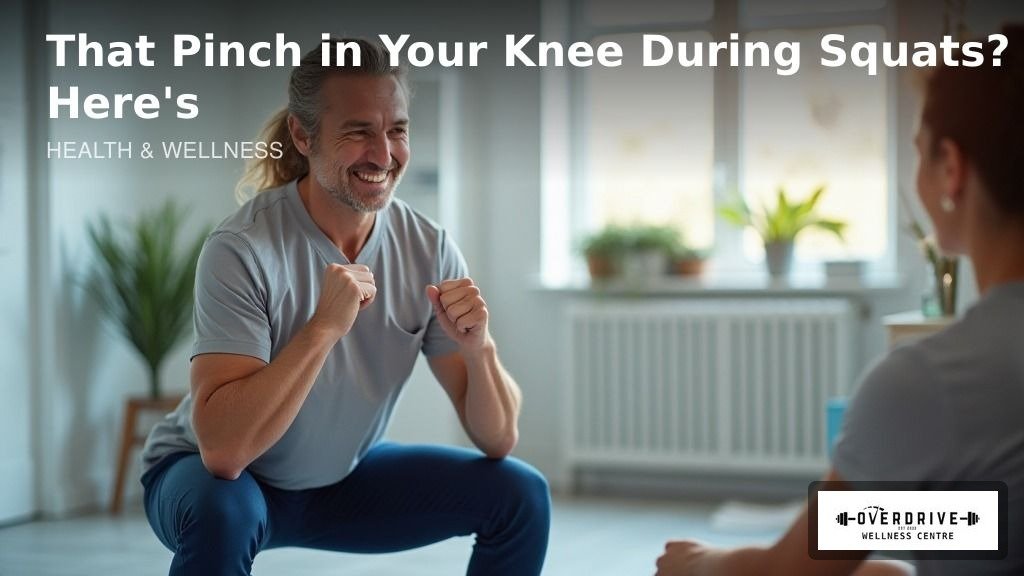
You’re set up for your first set of squats. You take a breath, brace your core, and start to descend. Everything feels fine until you’re about halfway down, and then you feel it—a sharp pinch or a dull, grinding ache right at the front of your knee. You push through the set, but the discomfort lingers. By the third set, you’re modifying your depth, and the frustration is starting to build. It’s a common story we hear from clients in our Richmond clinic: an exercise that’s supposed to build strength is instead causing pain and uncertainty.
Knee pain during a squat isn’t something to ignore or simply “push through.” It’s a signal from your body that something is out of balance. The good news is that it’s often correctable. The knee is usually just the messenger; the real issue often lies either above or below it.
Before you even add weight, try a bodyweight squat with your hands on your hips. If your knees dive inward before your hips have even dropped a few inches, your glute medius muscles likely aren’t firing. Focus on pre-activating these muscles with banded side steps or clamshells to build a more stable foundation.
Why Your Knees Hurt: The Usual Suspects
Your body is a kinetic chain, where movement (or lack thereof) in one joint affects the others. When it comes to squats, knee pain is rarely about having “bad knees.” More often, it’s a symptom of a problem at the hips or ankles.
1. Patellar Tracking and Anterior Knee Pain
This is that classic pain at the front of the knee, right around or under the kneecap (patella). Ideally, your kneecap glides smoothly in a groove at the end of your thigh bone (femur). When muscles around the hip and thigh are imbalanced—typically, with overactive quads and underactive glutes—the kneecap can be pulled slightly off-track. Instead of gliding, it rubs against the bone, causing irritation, inflammation, and pain. It might feel like a grinding sensation or a dull ache that gets sharper as you go deeper into the squat.
2. Limited Ankle Mobility
This is one of the most common and overlooked causes of poor squat mechanics. To squat deep with good form, you need adequate dorsiflexion—the ability to flex your foot toward your shin. If your ankles are stiff, your body has to find that range of motion elsewhere. What often happens is your heels lift off the ground, or your knees collapse inward (a movement called knee valgus). This inward collapse puts a tremendous amount of stress on the ligaments and structures on the inside of your knee, leading to pain.

3. Weak Hips and Glutes
Your gluteal muscles, particularly the gluteus medius on the side of your hip, are crucial for knee stability. Their job is to keep your thigh bone from rotating inward. When these muscles are weak or not firing properly, they can’t do their job. The result? That same knee valgus collapse we see with poor ankle mobility. Your knees dive toward each other on the way down or up from a squat, placing strain on the knee joint instead of loading the powerful muscles of the hips.
What You Can Try at Home: A DIY Action Plan
Before you give up on squats, there are a few safe and effective things you can try to address these common issues.
- Film Yourself: Set up your phone and record yourself squatting from the front and the side (just with bodyweight). Do your knees dive inward? Do your heels lift? Does your chest fall forward excessively? Seeing your own form is often a huge eye-opener.
- Ankle Mobility Drills: Try a simple wall ankle mobilization. Stand facing a wall with one foot forward, toes a few inches away. Keeping your heel planted firmly on the ground, gently bend your knee and try to touch it to the wall. Don’t force it. Hold for a couple of seconds and relax. Repeat 10-15 times per side.
- Glute Activation: Before you squat, you need to wake up your glutes. Try 15-20 glute bridges and a couple of sets of banded side steps (placing a resistance band around your knees or ankles and taking slow, controlled steps sideways). The goal is to feel a burn in the sides of your hips.
- Modify the Squat: Try squatting to a box or chair. This helps you learn to sit back into your hips, loading the glutes and hamstrings more effectively and taking pressure off the knees. Focus on keeping your knees pushed out (in line with your toes) throughout the entire movement.
When DIY Isn’t Enough
These self-help strategies can make a big difference, but sometimes the issue is more complex. You should stop and seek professional advice if you experience:
- Sharp, stabbing, or locking pain.
- Pain that persists for hours or days after your workout.
- Noticeable swelling, warmth, or redness around the knee.
- Pain that gets progressively worse despite your efforts to correct form.
- A feeling of instability, as if your knee might “give out.”
Guessing can lead to further injury. An accurate diagnosis is the fastest route back to pain-free movement. This is where professional guidance becomes essential, moving you from a cycle of trial-and-error to a clear, targeted plan.
When to Call a Professional
If your knee pain isn’t improving, it’s time to consult a physiotherapist. A trained professional can perform a thorough assessment to identify the root cause of your pain—whether it’s truly ankle mobility, hip weakness, a motor control issue, or something else entirely. They can distinguish between simple muscle imbalances and more significant structural issues.
Based on this assessment, they can build a personalized rehabilitation program. Our approach to physiotherapy and active rehab within our services involves more than just treating the symptom; we work to correct the underlying movement pattern. This might include hands-on manual therapy to improve joint mobility, specific strengthening exercises for underactive muscles, and coaching to retrain your squat pattern from the ground up. The goal isn’t just to stop the pain, but to build a more resilient body that can handle the demands you place on it. The expertise of our practitioners at Overdrive Wellness ensures you get a plan tailored precisely to your body and your goals.
Simple Steps for Long-Term Prevention
- Always Warm Up: Never jump straight into heavy squats. Spend 5-10 minutes doing dynamic stretches, mobility work, and activation drills.
- Make Mobility a Habit: Don’t just work on your ankle and hip mobility when you’re in pain. Incorporate it into your regular routine 2-3 times a week.
- Focus on Form Over Weight: Master the bodyweight squat first. It’s better to squat half the weight with perfect form than double the weight with poor mechanics that will eventually lead to injury.
- Listen to Your Body: A little muscle fatigue is normal. Sharp joint pain is not. Learn to tell the difference and don’t be afraid to back off or modify when something doesn’t feel right.
Squats are a fundamental human movement and a fantastic strength-building exercise. Knee pain doesn’t have to be a permanent barrier. By understanding what your body is telling you and taking the right steps, you can get back to squatting with confidence and strength. If you’re stuck and need help decoding those signals, we’re here to help you build a better foundation. Contact Overdrive Wellness today for a personalized assessment, and let’s get you moving comfortably again.
Why does my knee hurt at the front when I squat?
Is it okay to squat if my knees hurt a little?
How can I improve my squat form to protect my knees?
When should I see a physiotherapist for knee pain from squatting?
Last updated: 24 June 2026