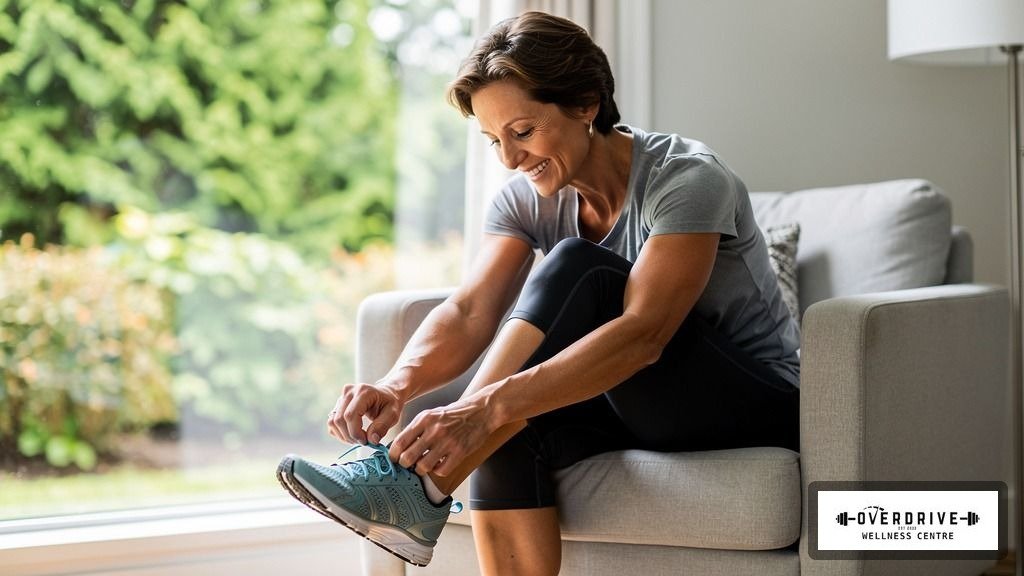
It’s a familiar story for many in Richmond. You swing your legs out of bed, place your foot on the floor, and a sharp, stabbing pain shoots through your heel. The first ten steps of the day are a hobbling, wincing ordeal before it gradually eases into a dull ache. You might blame the shoes you wore walking the West Dyke Trail, or maybe just getting older. But that persistent, frustrating heel pain—known as plantar fasciitis—is often a signal of a problem that starts much higher up your body.
While it’s easy to focus on the foot, where the pain is, at Overdrive Wellness, we find the root cause is frequently related to how you move. Your body is an interconnected system, and your feet are at the bottom of a kinetic chain, bearing the consequences of any dysfunction above.
Plantar fasciitis is rarely just a foot problem. Before spending hundreds on new shoes or orthotics, have a professional assess your hip stability and glute strength. Weakness further up the kinetic chain is a common culprit for overloading the tissues in your foot.
Why It Happens: More Than Just Bad Shoes
The plantar fascia is a thick, web-like ligament that connects your heel to the front of your foot. It acts as a shock absorber and supports the arch. Plantar fasciitis occurs when this ligament becomes inflamed and irritated from excessive stress or strain.
Common advice often points to footwear, arch supports, or stretching the foot itself. While these can provide temporary relief, they don’t address the fundamental question: why is the plantar fascia being overloaded in the first place? The answer often lies in your movement patterns.
Consider these common culprits:
- Weak Glutes and Hips: Your gluteal muscles are the powerhouse for stabilizing your pelvis and legs. When they are weak or not firing correctly (a common issue for those with desk jobs), other muscles have to compensate. This can cause your knee to collapse inward and your foot to over-pronate (roll in), placing immense, repetitive strain on the plantar fascia with every step.
- Poor Ankle Mobility: Limited range of motion in your ankle, particularly in dorsiflexion (the ability to pull your toes up toward your shin), forces your foot to find mobility elsewhere. This can lead to the arch collapsing during walking or running, again overloading the fascia.
- Calf Tightness: Chronically tight calf muscles pull on the Achilles tendon, which is connected to the heel bone right where the plantar fascia attaches. This constant tension creates a tug-of-war that irritates the fascia’s insertion point.
Essentially, your foot is taking the blame for a job that your hips, glutes, and calves aren’t doing properly. It’s a compensation pattern that, over thousands of steps a day, leads to inflammation and pain.
What You Can Try Yourself (For Symptom Relief)
While you work on getting a proper assessment, a few simple strategies can help manage the immediate pain:
- Gentle Rolling: Use a golf ball, lacrosse ball, or frozen water bottle to gently roll under the arch of your foot for a few minutes each day. This can help release tension and reduce inflammation. Don’t press so hard that it’s excruciating; it should be a “good hurt.”
- Calf Stretches: Lean against a wall with one leg back, heel on the floor, and gently stretch your calf muscle. Hold for 30-45 seconds on each side, and repeat 2-3 times.
- Reduce Barefoot Time: If you have hard floors, avoid walking barefoot for extended periods. Wear supportive indoor shoes or slippers to give your fascia a break.
These are excellent first-aid measures, but remember they are treating the symptom, not the underlying cause.
When DIY Isn’t Enough: The Professional Assessment
If your pain has lasted more than a few weeks, isn’t improving, or is stopping you from enjoying activities like a walk at Iona Beach, it’s time to look deeper. This is where a comprehensive movement assessment with a qualified professional becomes invaluable.
At Overdrive Wellness, our kinesiology services begin with a thorough evaluation that goes far beyond just your foot. A BCAK-registered Kinesiologist will guide you through a movement screen to identify the weak links in your kinetic chain. We’ll look at:
- Gait Analysis: How you walk and/or run.
- Single-Leg Stance: Assessing your balance and hip stability.
- Squat and Lunge Patterns: Revealing mobility restrictions and muscle imbalances.
- Glute and Core Strength Tests: Pinpointing specific areas of weakness.
This assessment gives us the ‘why’ behind your pain. From there, our team of kinesiologists develops a personalized corrective exercise program designed not just to calm the inflammation, but to fix the mechanical issues that caused it.
A Typical Recovery Timeline
Recovery is a process that requires consistency and patience. While every individual is different, a structured approach generally follows these phases:
| Phase | Focus |
|---|---|
| Phase 1: Pain & Inflammation Reduction | Gentle mobility, reducing load on the fascia, and pain management techniques. |
| Phase 2: Activation & Mobility | Activating dormant muscles (like glutes) and improving ankle/hip mobility. |
| Phase 3: Strengthening & Integration | Building strength in the entire kinetic chain and integrating new movement patterns. |
| Phase 4: Return to Activity | Gradually re-introducing activities like running or sports with proper form. |
Prevention: Keeping Heel Pain Away for Good
Once you’re pain-free, the goal is to stay that way. The corrective exercises you learn aren’t just for recovery; they are the foundation for long-term prevention. Maintaining hip and core strength, ensuring good ankle mobility, and performing dynamic warm-ups before exercise are key to preventing a recurrence. It’s about building a more resilient body that distributes forces evenly, so no single tissue has to take on an unfair share of the load.
Take the First Step Towards a Real Solution
If that sharp morning heel pain is dictating your life, it’s time to stop chasing symptoms and start addressing the cause. A thorough assessment of your movement is the first step toward lasting relief and getting back to the active Richmond lifestyle you enjoy.
Contact Overdrive Wellness today to book a consultation and learn how a personalized kinesiology program can help you move past plantar fasciitis for good.
What is the main cause of plantar fasciitis?
How long does it take to recover from plantar fasciitis with kinesiology?
Can I still exercise with plantar fasciitis?
Why is a movement assessment important for heel pain?
Last updated: 30 July 2026