
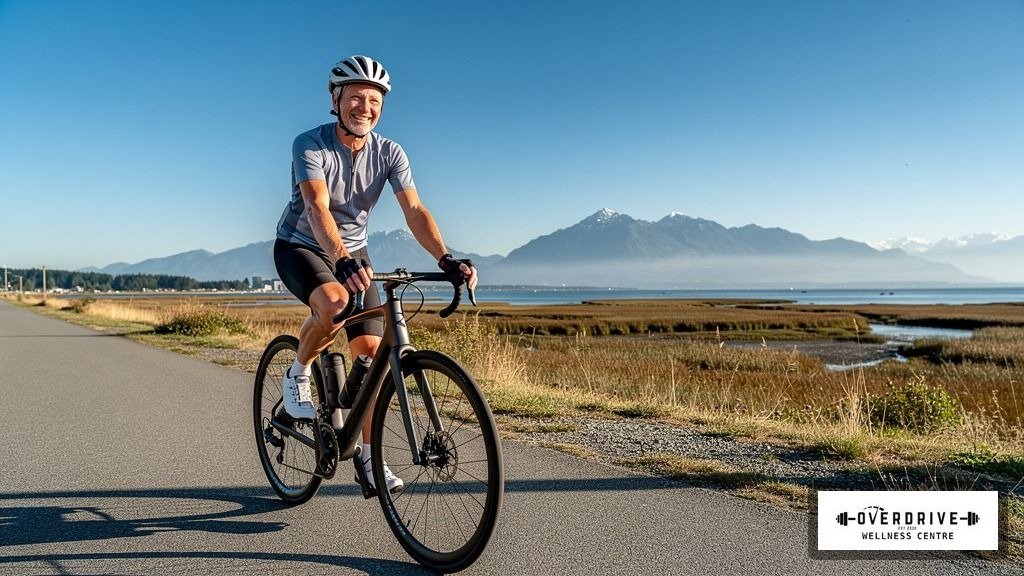
The first truly sunny weekend arrives in Richmond. You pull your bike from the garage, pump up the tires, and head straight for the West Dyke Trail, dreaming of that long ride out to Steveston. The first 10 kilometres feel fantastic—the freedom, the fresh air. But then, a familiar, unwelcome ache starts on the outside of your knee. By the time you’re heading home, it’s a sharp, nagging pain that makes climbing the stairs a real chore. If this scenario feels a little too real, you’re not alone.
Every spring, we see a wave of recreational cyclists who jump back on the bike with enthusiasm, only to be sidelined by preventable aches and pains. The flat, scenic routes around Richmond are a cyclist’s paradise, but they can also expose underlying issues that were dormant all winter.
Before your first long ride, spend 10 minutes on dynamic movements like leg swings and glute bridges. This activates key cycling muscles and is far more effective for preventing injury than holding static stretches on cold muscles.
Why That Nagging Pain Keeps Coming Back
Cycling injuries rarely happen because of one single bad ride. They’re usually the result of cumulative stress on a system that isn’t quite prepared for the demand. Here are the most common culprits we see in our clinic:
- The ‘Too Much, Too Soon’ Trap: Your cardiovascular system might feel ready for a 40km ride, but your muscles, tendons, and ligaments are not. After a less active winter, jumping straight into long distances is a shock to the tissues, leading to inflammation and strain in areas like the IT band, knees, and lower back.
- Underlying Muscle Imbalances: Many of us spend our workdays sitting, which leads to tight hip flexors and underactive, weak gluteal muscles. When you get on the bike, your body defaults to overusing the quadriceps and hamstrings. Without strong glutes and a stable core to support the pelvis, extra strain is transferred to your lower back and the structures around your knee.
- A Poor Bike Fit: This is perhaps the single biggest factor in non-traumatic cycling injuries. A saddle that’s too high or low, handlebars that are too far away, or incorrect cleat position can place enormous, repetitive stress on your joints. That knee pain might not be a ‘knee problem’ at all, but a ‘bike fit problem’.
- Neglecting Mobility: Cycling is a repetitive motion in a single plane of movement (forward). Over time, this can lead to stiffness in your hips and thoracic (mid-back) spine. Without movements that counter this pattern, your body loses its ability to move freely, forcing joints into compromised positions on and off the bike.
A 10-Minute Pre-Ride Routine to Bulletproof Your Body
Before you head out, your goal isn’t to hold long, static stretches on cold muscles. It’s to wake up and activate the key muscles that support you on the bike. This simple routine can make a world of difference.
Your Movement Prep Program:
- Glute Bridges (2 sets of 15 reps): Lie on your back with your knees bent and feet flat on the floor. Drive through your heels and lift your hips toward the ceiling, squeezing your glutes at the top. This wakes up the powerhouse muscles that should be doing most of the work.
- Cat-Cow (10-12 reps): Start on all fours. Inhale as you drop your belly and look up, arching your back. Exhale as you round your spine, tucking your chin to your chest. This mobilizes your spine.
- Leg Swings (15 per leg, each direction): Standing and holding onto something for balance, swing one leg forward and backward, then side to side. This dynamically opens up the hips.
- Bird-Dog (2 sets of 10 reps per side): From all fours, extend your opposite arm and leg straight out, keeping your core tight and your back flat. This teaches your core to stabilize your pelvis—critical for cycling.
Save the foam roller and deeper stretches for *after* your ride to help with recovery.

When Your DIY Efforts Aren’t Enough
A little muscle soreness after a long layoff is normal. But certain signs indicate a deeper issue that needs professional attention. Don’t ignore these signals:
- Pain that is sharp, shooting, or accompanied by numbness or tingling.
- Pain that gets progressively worse with each ride, even with a warm-up.
- An ache that forces you to change how you walk or take the stairs.
- Pain that lingers for more than 48 hours after you ride.
- The same injury returning season after season.
When to Call a Professional
If you’re stuck in a cycle of pain and frustration, it’s time for a more targeted approach. A recurring injury is your body’s way of telling you there’s an underlying imbalance that a generic warm-up can’t fix. This is where the expertise of a qualified practitioner becomes invaluable.
Working with a BCAK-registered Kinesiologist can uncover the root cause of your discomfort. Through a detailed assessment, they can identify specific weaknesses, mobility restrictions, or faulty movement patterns. From there, they can design a personalized program to address those specific issues. The practitioners on our Meet the team – Overdrive Wellness page have extensive experience helping local athletes and weekend warriors move past these exact problems.
For more acute tightness and pain, a Registered Massage Therapist (RMT) can be a great first step. They can help release chronically tight muscles, reduce inflammation, and improve tissue health, which often makes your strengthening exercises more effective. You can learn more about the different disciplines we offer on our Services – Overdrive Wellness page.
Long-Term Prevention for a Full Season of Riding
Getting rid of pain is the first step. Keeping it away is the goal. Here’s how:
- Get a Professional Bike Fit: We can’t stress this enough. It is the best investment you can make for your cycling longevity.
- Strength Train Year-Round: Don’t just be a cyclist. Be an athlete who cycles. Two days a week of foundational strength work (squats, deadlifts, rows, core exercises) builds a resilient frame that can handle the demands of the bike.
- Listen to Your Body: An extra rest day is always better than a six-week injury layoff. Don’t push through sharp pain.
Don’t let that nagging ache cut your cycling season short again this year. If you’re ready to understand the ‘why’ behind your pain and build a stronger, more resilient body, contact Overdrive Wellness. Let’s create a plan to keep you riding strong and pain-free on the beautiful trails of Richmond.
Why does the outside of my knee hurt when I cycle?
Is foam rolling good for cyclists before a ride?
How can a Kinesiologist help with my cycling pain?
Should I get a bike fit before or after seeing a practitioner?
Last updated: 27 July 2026