
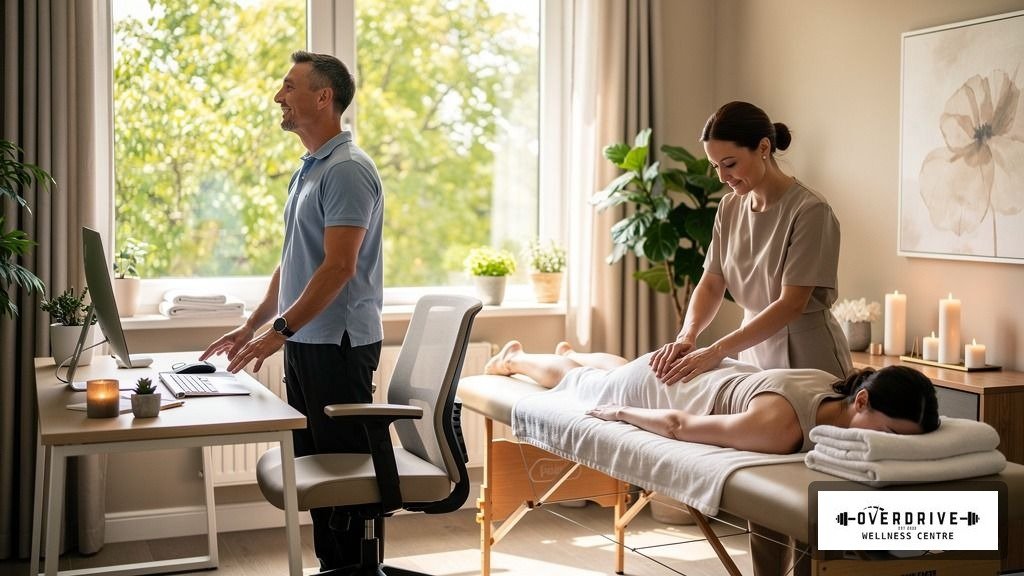
It’s 4:45 PM. You’ve just wrapped up the last video call of the day, finished that report, and as you push your chair back to finally stand up, you feel it: a familiar, dull, grinding ache right at the front of your knee. It’s not sharp, but it’s persistent. You find yourself putting a hand on your desk to brace yourself as you straighten your leg, waiting a moment for the stiffness to subside before you can walk normally. If this sounds like your daily routine, whether you’re in a home office or part of Richmond’s growing tech and professional services sector, you’re not alone. This type of knee pain is incredibly common among desk workers, and the culprit is often not the knee itself, but the chair you’ve been sitting in all day.
Why Your Desk Job Is Making Your Knees Ache
It seems counterintuitive. How can sitting, an activity that puts no direct load on your knees, cause them to hurt? The answer lies in a chain reaction of muscle imbalance that starts much higher up, at your hips. Our bodies are designed for movement, and when we sit for hours on end, we create a predictable pattern of dysfunction:
Your knee pain often isn’t a knee problem, but a hip problem in disguise. Prolonged sitting weakens your glutes and tightens your hip flexors, forcing your thigh muscles to overcompensate and pull your kneecap out of alignment. Activating your glutes before and after sitting can make a significant difference.
- Tight Hip Flexors: The muscles at the front of your hips (your hip flexors) are held in a shortened, contracted position while you sit. Over time, they become chronically tight and short.
- Inactive Glutes: While your hip flexors are tight, your glutes—the powerful muscles in your buttocks—are lengthened and inactive. This phenomenon is often called ‘gluteal amnesia.’ Your brain essentially forgets how to fire these muscles effectively because they aren’t being used.
- Overworked Quads: With your primary hip extensors (the glutes) offline, other muscles have to pick up the slack. Your quadriceps (thigh muscles) and hamstrings take on jobs they weren’t designed to lead. This imbalance puts excessive strain on the patellar tendon and can cause your kneecap (patella) to track improperly in its groove on the femur (thigh bone).
This poor tracking is what creates that grinding, achy sensation known as patellofemoral pain syndrome (PFPS), one of the most common causes of ‘desk knee.’ It’s a classic case of the victim (the knee) screaming while the culprit (the hip and glute imbalance) sits silently by.
What a Kinesiology Assessment Reveals
When someone comes to our Richmond clinic with this kind of pain, we don’t just look at the knee. A qualified kinesiologist is a human movement specialist. Our job is to analyze how your entire body works as a system to identify the root cause of your discomfort. We’ll watch you walk, squat, and perform specific movements to see these imbalances in action. We might find that your hips are stiff, your glutes aren’t firing when you extend your leg, or your core is unstable, forcing your lower body to compensate. Our team of BCAK-registered kinesiologists are trained to spot these subtle patterns that lead to chronic pain, creating a roadmap for recovery that addresses the source of the problem.
Many clients ask about the difference between a kinesiologist and a physiotherapist. While both are regulated health professionals who help with pain and injury, their focus differs. A physiotherapist often uses modalities like ultrasound or manual therapy to diagnose and treat acute injuries. A kinesiologist, on the other hand, is a human movement specialist who uses exercise prescription and active rehabilitation as their primary tool. They focus on correcting faulty movement patterns, improving functional strength, and providing education to prevent re-injury, making them ideal partners for tackling chronic, activity-related issues like desk knee.

3 Corrective Exercises to Start With
While a personalized plan is always best, here are three foundational exercises that target the common causes of desk-related knee pain. Perform them slowly and with control. The goal is to re-establish a mind-muscle connection, not to build brute strength.
1. Glute Bridges
This exercise is designed to ‘wake up’ your sleepy glutes.
- Lie on your back with your knees bent, feet flat on the floor hip-width apart, and your arms by your sides.
- Before you lift, consciously squeeze your glute muscles.
- Keeping that squeeze, lift your hips off the floor until your body forms a straight line from your shoulders to your knees.
- Hold for 2-3 seconds at the top, focusing on the glute contraction. Avoid arching your lower back.
- Lower your hips back down with control. Aim for 2-3 sets of 12-15 repetitions.
2. Kneeling Hip Flexor Stretch
This helps lengthen the muscles that get tight from sitting.
- Kneel on one knee, as if you were proposing. Place a cushion under your knee if needed.
- Ensure your front foot is far enough forward that your knee is directly over your ankle.
- Keeping your back straight and your core engaged, gently tuck your tailbone under and squeeze the glute of the kneeling leg. You should feel a gentle stretch in the front of that hip.
- Hold for 30-45 seconds, breathing deeply. Do not lean forward to intensify the stretch; the magic is in the pelvic tilt.
- Repeat 2-3 times on each side.
3. Wall Sits
This isometric exercise strengthens the quadriceps and improves kneecap stability without painful movement.
- Stand with your back against a wall and your feet about shoulder-width apart, a couple of feet away from the wall.
- Slide your back down the wall until your knees are bent at a 45 to 90-degree angle. Don’t go so low that you feel pain.
- Ensure your knees are aligned directly over your ankles, not drifting inward or outward.
- Hold this position for 30-60 seconds, focusing on keeping your core tight and breathing steadily.
- Slide back up the wall to rest. Repeat 3-5 times.
When DIY Isn’t Enough (And When to See a Chiropractor)
These exercises can provide significant relief, but sometimes the issue is more complex. If your pain is sharp, getting worse, involves clicking or locking, or wakes you up at night, it’s time to stop the DIY approach. This is where a holistic wellness model shines. While a kinesiologist is your expert for muscle activation and movement retraining, a chiropractor can be a crucial partner in your recovery. A chiropractor, who in BC is regulated by the College of Chiropractors of BC, can assess for joint restrictions in the knee, hip, or even the lower back and pelvis that might be contributing to the faulty mechanics. Our integrated approach often involves collaboration between our practitioners to ensure all aspects of your issue are addressed. At Overdrive Wellness Centre, our team includes both kinesiologists and chiropractors who work side-by-side to provide comprehensive care. You can learn more about our full range of services and how they work together.
Prevention: Your Best Defence
The best way to deal with desk knee is to prevent it from starting.
- The 30/30 Rule: For every 30 minutes you sit, take at least 30 seconds to stand up, stretch, and walk around.
- Ergonomic Tune-Up: Adjust your chair so your hips are level with or slightly higher than your knees. This opens up the hip angle and reduces strain.
- Active Sitting: Don’t just plant yourself in one position. Shift your weight, use a footrest, and consciously engage your core periodically.
- Lunchtime Movement: Use your break to take a walk. A quick loop around your Richmond neighbourhood or a nearby park can do wonders to reset your body.
That nagging ache isn’t something you have to live with. It’s your body’s signal that an imbalance needs to be corrected. By understanding the ‘why’ behind the pain, you can take targeted, effective steps to feel better. If you’re ready to move beyond temporary fixes and address the root cause of your knee pain, book your assessment online or call our Richmond clinic at (604) 270-1234 to get started. Let’s get you moving comfortably again.
Why does my knee hurt from sitting but not from walking?
Can a kinesiologist fix knee pain?
How should I sit at my desk to avoid knee pain?
When should I see a chiropractor vs. a kinesiologist for knee pain?
Last updated: 6 July 2026