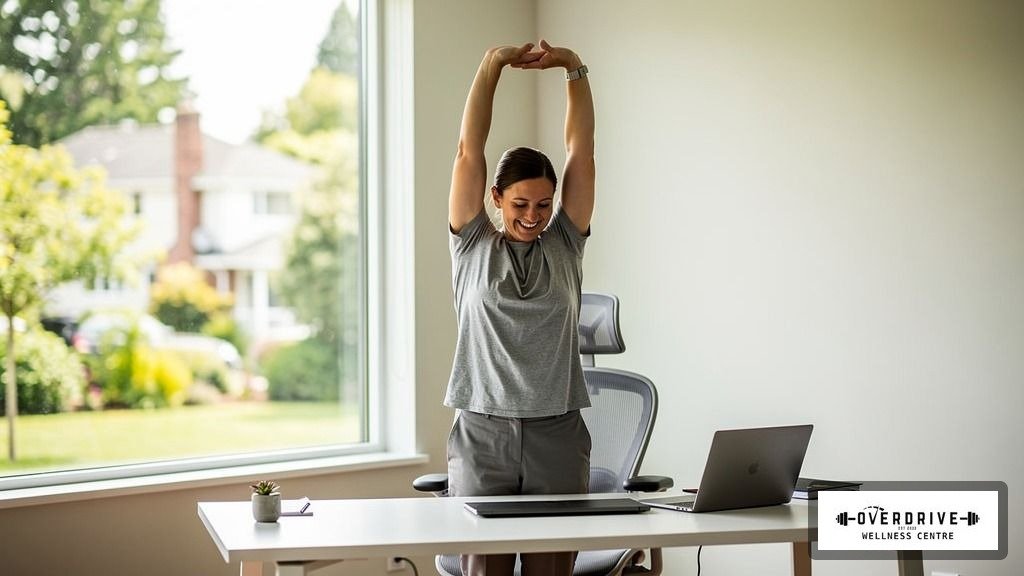
It’s 4:55 PM. You’re wrapping up the last few emails at your desk, whether you’re in a tech office near the Oval or working from your home in Steveston. You push your chair back and stand up, and there it is—that familiar, deep, grabbing sensation at the front of your hip. It might be a dull ache or a sharp tightness that forces you to take a moment before you can fully stand up straight. For many of Richmond’s desk-bound professionals, this is the daily sign-off.
This nagging discomfort may be related to tight hip flexors, especially if you spend long periods sitting. While it seems like a minor annoyance, over time it can contribute to lower back pain, poor posture, and inefficient movement patterns that affect everything from your weekend hike in the Richmond Nature Park to your performance in the gym.
Don’t just stretch your hip flexors; activate your glutes. Tight hips often come with weak glutes. After a gentle hip flexor stretch, perform 10-15 glute bridges, focusing on squeezing your glutes at the top to restore muscle balance and support your pelvis.
Why Your Hips Feel So Tight After Sitting
Your hip flexors are a group of muscles, most notably the iliopsoas, that run from your lower spine and pelvis to the top of your thigh bone. Their job is to lift your knee towards your chest. When you sit for hours—at your desk, in your car on Highway 99, or commuting on the Canada Line—these muscles are held in a shortened, flexed position.
Over time, the body adapts. The muscles may become stiff, overactive, or less tolerant of lengthened positions. This constant tension can pull your pelvis forward into a position called an anterior pelvic tilt. Imagine your pelvis as a bowl of water; an anterior tilt is like tipping the water out of the front. This has a few knock-on effects:
- Lower Back Strain: The forward tilt increases the arch in your lower back, compressing the joints and leading to that persistent, dull ache.
- Weak Glutes: When one muscle group is chronically tight (the hip flexors), the opposing muscle group (the glutes) tends to become underactive and weak. This is a phenomenon known as reciprocal inhibition.
- Inefficient Movement: With weak glutes and tight hips, your body has to find other ways to generate power for walking, running, or squatting, often over-stressing your lower back and hamstrings.
A Quick Self-Assessment You Can Do at Home
Curious if your hip flexors are the culprit? You can try a modified version of the Thomas Test. Be gentle and stop if you feel any sharp pain.
Lie on your back on the edge of your bed. Let one leg hang off the side. Grab the other knee and pull it firmly towards your chest. Now, look at the leg that’s hanging off the bed. Does it lift off the surface? Is the knee unable to bend to 90 degrees? If your thigh lifts up, it may suggest hip-flexor tightness, but it should not be treated as a diagnosis.
What You Can Try Yourself: The Right Way to Stretch
Stretching can provide relief, but only if it’s done correctly. The goal is to lengthen the muscle, not just crank your back into a deeper arch. Here’s a safe and effective stretch:
The Kneeling Hip Flexor Stretch:
- Kneel on a soft surface with one knee down (the side you want to stretch) and the other foot forward, creating a 90-degree angle at both knees.
- This is the most important part: Before you lunge forward, gently tuck your tailbone under and squeeze the glute of your back leg. You should feel a gentle stretch at the front of your hip already. This stabilizes your pelvis and isolates the stretch.
- Without losing that pelvic tuck, slowly shift your weight forward. You don’t need to go far.
- Hold for 30-45 seconds, breathing deeply. Avoid arching your lower back.
Perform this stretch 2-3 times per side, once or twice a day. Consistency is more important than intensity.
Stop the stretch and seek professional advice if you feel sharp groin pain, numbness, tingling, weakness, pain after a fall or injury, night pain, fever, unexplained weight loss, or symptoms that continue to worsen.
When Stretching Isn’t Enough
Sometimes, stretching alone doesn’t resolve the issue. You might be in this boat if:
- The tightness returns almost immediately after stretching.
- You feel a sharp pinching sensation in the front of your hip when you try to stretch.
- The pain is constant, not just when you stand up.
- You’ve been stretching for weeks with no real improvement.
This often means the problem is more complex than simple tightness. It could involve muscle imbalances, joint restriction, or motor control issues that stretching can’t fix. This is when a professional assessment becomes crucial.
How a Professional Can Help Break the Cycle
At Overdrive Wellness, we see this issue frequently among Richmond’s office workers. A professional assessment goes beyond just identifying a tight muscle. A qualified BCAK Practicing Member kinesiologist can conduct a full movement screen to better understand the movement patterns and strength imbalances that may be contributing to your symptoms.
Our approach to active rehabilitation, which you can read more about on our services page, involves a comprehensive plan. Where appropriate and within the practitioner’s training and scope, this may include manual release techniques, followed by a targeted program of corrective exercises. The focus isn’t just on more stretching; it’s on strengthening the muscles that *should* be doing the work—your glutes and deep core stabilizers. By restoring this balance, we help your body move more efficiently and take the chronic strain off your hips. The expertise of our practitioners is key to building a program that works for your specific body and lifestyle; you can meet the team to learn about their individual approaches.
Prevention: Keeping Your Hips Happy at Work
The best long-term solution is to integrate more movement into your day.
- The 30-Minute Rule: Set a timer to stand up, stretch, and walk around for a minute or two every half hour.
- Optimize Your Ergonomics: Adjust your chair so your hips are level with or slightly higher than your knees. This opens the hip angle.
- Incorporate ‘Movement Snacks’: A few times a day, perform 10 bodyweight squats or glute bridges. This reminds your glutes to stay active.
- Strengthen the Opposites: Make glute bridges, planks, and bird-dog exercises a regular part of your fitness routine to build a strong, stable core and pelvis.
If that deep hip ache sounds all too familiar and you’re tired of the cycle of sitting, stiffness, and temporary relief, it’s time for a more targeted strategy. Contact Overdrive Wellness today, and let’s create a plan to help you move and feel better, both in and out of the office.